
 80813-00200


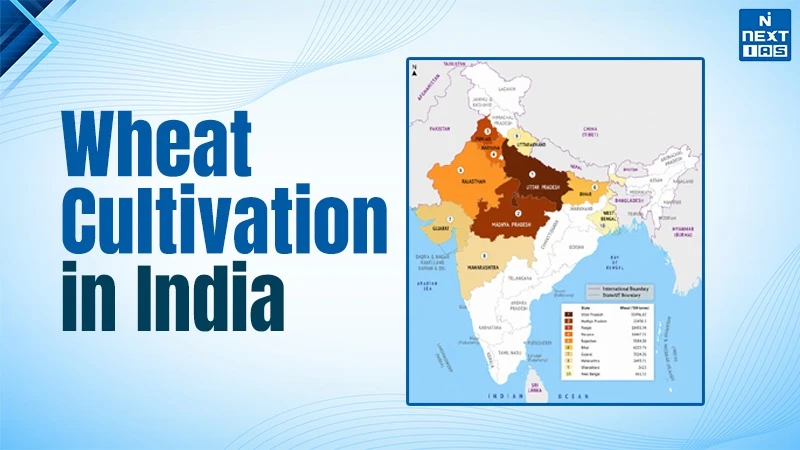
India grows many crops, including wheat, which is one of its major rabi crops. It is an essential crop for the country's food security and also plays an important role in rural livelihoods. It is a crop that needs a cool environment during growth, moderate rain of about 50 to 75 cm, and sunlight during ripening. Well-drained fertile alluvial and loamy soils are very ideal for growing this crop.
Major states that grow this crop include Uttar Pradesh, Madhya Pradesh, Punjab, Haryana, Rajasthan, and Bihar. Wheat growing is predominant in the northwest Indo-Gangetic Plains region because of ideal soil, water and climatic conditions.
About Wheat
- Wheat is the second most important staple food for the Indian population.
- It is a rich source of:
- Calcium,
- Thiamine,
- Riboflavin, and
- Iron.
- It is preferred as a staple food in northern and northwestern parts of the country.
Climatic Conditions for Wheat Cultivation
- Wheat is a temperate crop that requires a cool climate with moderate rainfall. It shows excellent adaptability & can be grown in the tropics as well (yields are low in the tropics).
- It is a Rabi crop (winter crop -- requires a cool and less moist climate).
- Wheat requires 75 cm of temporally (time) well-distributed rainfall for its cultivation.
- The 100 cm rainfall limit is the highest limit for rice, as 100 cm isohyets separate wheat-growing areas from rice-growing areas.
- In the Kharif season, rice replaces wheat in the 'winter wheat belt' region -- Punjab, Haryana etc. Drizzles and cloudiness (E.g., Weather brought by Western Disturbances) at the time of ripening help increase the yield. During the flowering period, a frost or hail storm harms the wheat.
| Region | Sowing Months | Harvesting Months |
|---|---|---|
| Karnataka, Maharashtra, Andhra Pradesh, Madhya Pradesh and West Bengal (central and southern peninsular agro-climatic region). | September-October | January-February |
| Bihar, Uttar Pradesh, Punjab, Haryana and Rajasthan (northeastern plains and northwestern plains agro-climatic region). | October-November | February-march |
| Himachal Pradesh and Jammu and Kashmir. | November-December | April-May |
Soil Condition for Wheat Crop
- Well-drained, fertile, friable barns (mostly alluvial) and clay loams (a good proportion of sand) are best for wheat cultivation.
- It also grows well in the black soil of the Deccan plateau.
- Thus, wheat cultivation is more flexible than rice cultivation as the limiting factors are low.
- Wheat cultivation depends on the level of mechanisation, compared to rice. However, wheat requires less labour work.
Production of Wheat in India
- India is the second-largest wheat producer in the world after China. Wheat cultivation accounts for 13 per cent of the country's cropped area.
- The highest production of wheat in India comes from the states of Uttar Pradesh, Punjab, and Haryana, with Uttar Pradesh leading as the top producer due to its fertile alluvial soil and extensive irrigation network.
- India has done better in wheat cultivation by achieving yields closer to the global average.
- It has recorded an average yield of 3.37 tonnes per hectare.
- However, it is still far from countries like France (6.84 tonne), Germany (6.67 tonne) and China (5.42 tonne). Production of wheat can be increased by the following measures:
- Area-specific technology has to be used, e.g., micro-irrigation in dry areas of the Deccan Region.
- Improved supply of better seeds.
- Better supply of fertilisers.
- Control of weeds, pests and diseases.
Top 5 Wheat Producing States
- Wheat production is mainly confined to the northwestern parts of the country. Punjab, Haryana, and the western parts of U.P. have earned the distinction of being called the 'Granary of India'.
- Other important wheat-producing states are Bihar, Gujarat, West Bengal, Maharashtra, Uttarakhand and Himachal Pradesh.
| State | Rank | Positive factor | Negative factor |
|---|---|---|---|
| Uttar Pradesh | 1st | The fine alluvial soil deposited by river Ganga and its tributaries. Close network of canal, supplemented by a large number of tube wells. The doab is the best wheat-producing area, e.g., Ganga-Yamuna doab. | Wheat production to the east of Varanasi declined due to high rainfall. |
| Madhya Pradesh | 2nd | The climate is well suited for wheat cultivation in winter. | Less fertile soil, less developed irrigation facilities, Low yield. |
| Punjab | 3rd | Green Revolution was utilised to the fullest. Excellent irrigation system provided by a close network of canal and tube wells. Light rainfall is associated with western disturbance in winter. Fertile alluvial soil brought by the rivers. Punjab farmers are progressive and willing to adopt new technology. | Land degradation and groundwater depletion. |
| Haryana | 4th | Same as in Punjab | Same as in Punjab. |
| Rajasthan | 5th | Indira Gandhi Canal has made wheat cultivation possible in many parts of Rajasthan. | Vast stretches of sandy desert, scarcity of rainfall, paucity of irrigation facilities, and land degradation. |
Global Leaders in Wheat Production
- China -- The largest wheat producer globally, with significant production in the North China Plain and Yangtze River basin.
- United States -- Major wheat producer, particularly in states like Kansas, North Dakota, and Washington, known for its high-quality wheat varieties.
- Russia -- One of the top wheat producers, with extensive cultivation in the southern and central regions of the country, including the Volga region and Siberia.
FAQs about Wheat Crop
Wheat crop falls into which category in India?
Wheat is a rabi crop and is usually grown in winters and harvested in springs or summers.
In which climatic conditions can wheat be cultivated?
Cool climate, moderate rainfall, good irrigation and sunshine in the ripening period are climatic conditions needed for wheat cultivation.
Which Indian states are important producers of wheat?
Important wheat producing states in India include Uttar Pradesh, Madhya Pradesh, Punjab, Haryana, Rajasthan and Bihar.
In which soil can wheat be cultivated?
Alluvial and loamy soil are considered the most appropriate soils for wheat cultivation.
Why wheat cultivation is important for India?
Wheat is important for India as it provides food security to the nation. It is an important staple food for Indians.
